

Cart 0

What are the Benefits of Water Technology for Commercial Floor Scrubbers?
A scrubber drier is only as efficient as the water it puts on the floor. Too much and you’re refilling more often, paying for detergent the floor didn’t need and mopping up puddles when the machine stops. Water technology is there to prevent all of that, from controlling how much water and detergent reaches the floor to how the tanks are filled and kept hygienic.
It can cut waste and make the operator’s job simpler, which is why scrubber drier water saving matters on so many sites. Our AquaControl system, for example, can save up to 50% of water on selected Scrubmaster models and we’ll explain below how to read that figure. To see where a saving like that comes from, it helps to know what water technology covers.
What Counts as Water Technology on a Scrubber Drier?
It’s the set of features that manage water and cleaning solution, instead of just a tank and a pump. Some features control the flow of water, some look after dosing and some keep the tanks clean. The mix differs from model to model and this post sticks to reducing and controlling the water that goes onto the floor.
A scrubber drier has two tanks. The solution tank holds the clean water and detergent that goes onto the floor and the recovery tank collects the dirty water the squeegee picks up. Water technology works on both, controlling how the solution is applied and making each tank easier to keep clean.
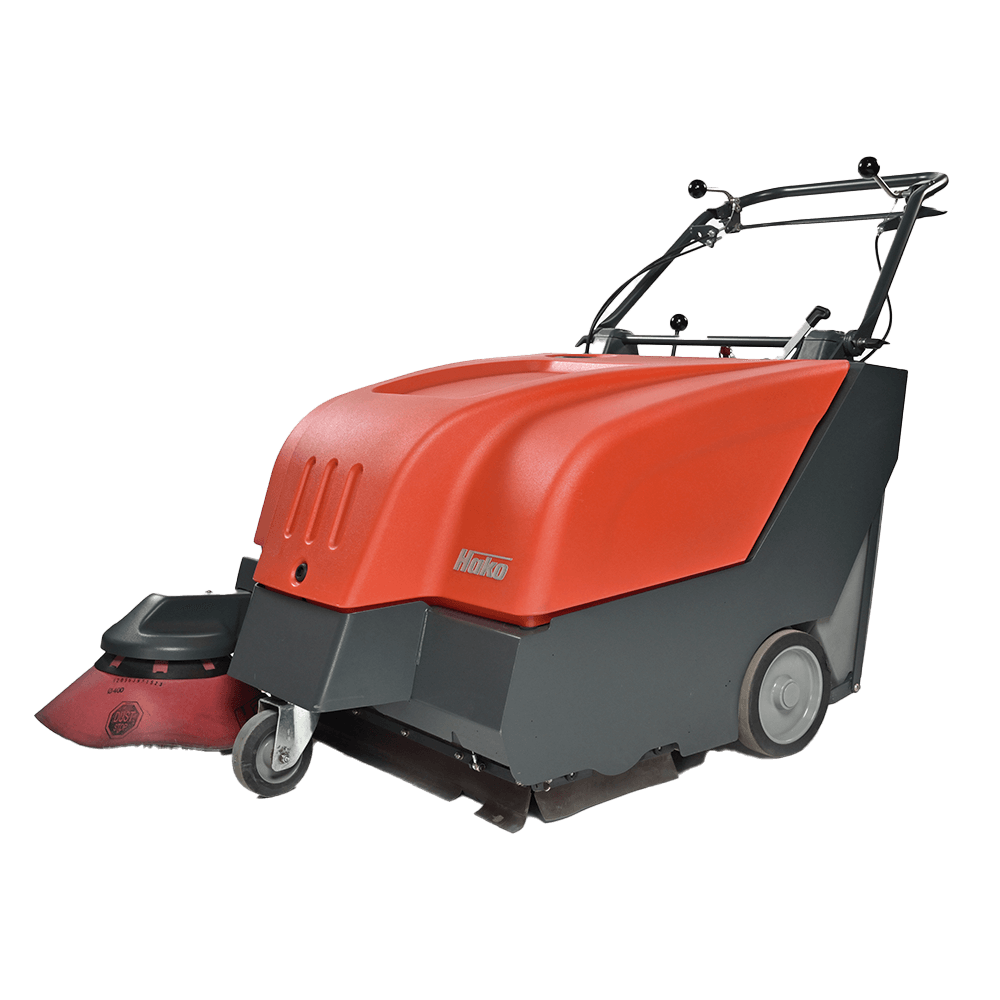
You’ll find these features across the Hako Scrubmaster range and they often set one specification apart from another. Which machine suits you depends mainly on the size of your space. Our ride-on scrubber driers suit larger areas, where the operator rides on the machine. Our pedestrian scrubber driers are walk-behind machines for tighter spaces.
How Do AquaControl and AquaStop Reduce Water Use?
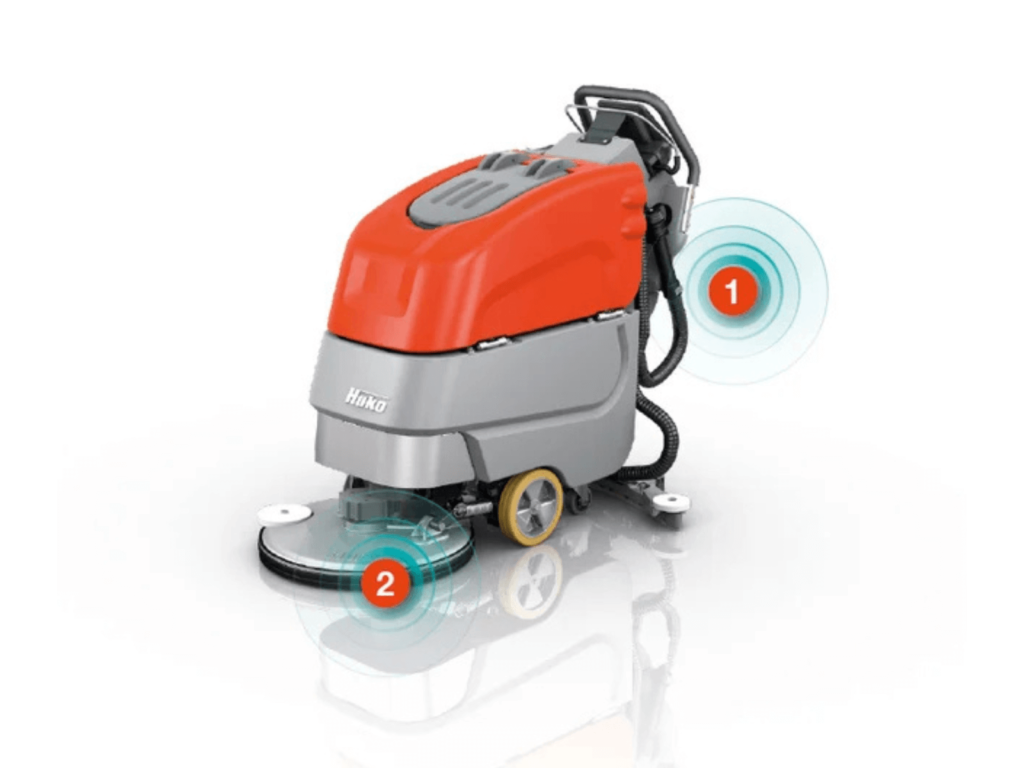
Picture a scrubber drier pausing at the end of an aisle. If the water kept flowing, the floor would be left wet exactly where the machine stood. Hako AquaControl is built to prevent that, combining intelligent brush control with an auto water stop scrubber function. When the machine is stationary, the water stops flowing automatically, so the operator doesn’t need to remember to switch it off at every pause or turn. That means less water on the floor to recover afterwards and it saves cleaning agent and cuts set-up and refilling time too.
We state a saving of up to 50% of water on the Scrubmaster B400R, where the feature is listed as AquaStop and the same figure applies to the B260R and B175R. The smaller Scrubmaster B25 states it for the water used during operation.
So how should you read that figure? “Up to 50%” is the most we state for a machine and your own saving depends on the machine and how it’s driven. A site with lots of stopping, turning and pausing gives the automatic water stop more chances to work, which makes it a good place to look for savings. Other Scrubmaster models carry AquaControl too, though we don’t quote a percentage for them and some variants add extra features. On the Scrubmaster B70, for example, speed-controlled solution application is available from the B 70 CL variant. Tell us about your site and we’ll help you work out what to expect.
What Happens If You Overdose Floor Cleaning Chemicals?
More detergent isn’t always better. Overdosing raises your detergent costs and puts extra strain on materials and it adds more chemical to the wastewater. Underdosing causes problems too, as the floor may not come up as clean as you’d like. An auto dosing floor scrubber takes the guesswork out of the mix and our dosing and filling systems are built around that accuracy.
Detergents can cause pollution if they reach the wrong place, which is another reason to dose carefully. The GOV.UK pollution prevention guidance for businesses names them as an example. That guidance applies to England and Scotland, Wales and Northern Ireland have their own. Any cleaning chemical also needs a risk assessment under COSHH, the rules on controlling hazardous substances at work. Concentrated detergents are one way to cut down on water too and we say our detergent solutions in concentrate need less of it. Getting the detergent right matters as much as getting the dose right and the best choice depends on your floor, so what detergent to use with a scrubber drier is a handy place to begin.
Can Automatic Filling Save Time on Site?
With an automatic tank filling scrubber drier setup, a float switch (a simple level sensor) stops the water supply once the solution tank is full, so the operator can get on with other jobs instead of standing by.
The result is less downtime and less overflow, which means less wasted water and no wet patch where the tank was filled. Wall-mounted automatic dosing is available too. These are filling stations and systems from our dosing and filling range rather than features built into one particular machine, so tell us about your site and we’ll help you choose the arrangement that suits it.
How Do Antibacterial Scrubber Drier Tanks Work?
Tanks that stay damp between shifts are where bacteria and mould can build up and that’s the problem AntiBac is designed to tackle. It’s an antibacterial coating on the plastic surface of the solution and recovery tanks. Instead of relying on cleaning alone, it works to stop bacteria and mould taking hold on the tank surface in the first place.
So what do you get from it? In laboratory tests to ISO 22196, the coating achieved up to a 99.9% reduction in various bacteria strains and mould on the tank surface. We say that means tanks that stay cleaner with less cleaning effort, fewer unpleasant odours from bacteria and mould growth and less contact between your team and bacteria when they empty and clean the tanks. We also say it reduces the need for tank-cleaning disinfectants, which means fewer chemicals to buy, handle and dispose of.
It helps to know what AntiBac covers, as it protects the tank surface only. It doesn’t treat the cleaning water and it isn’t a floor disinfectant, so it reduces the work of keeping tanks hygienic rather than taking it away. It’s optional on some Scrubmaster models and listed on others, so be sure to ask our team.
How Do Filters and Tank Design Help Control Water?
Small design details make a big difference to how easily an operator can keep the water side of a machine clean. These are the ones we’d point to:
• Scrubmaster B5: the removable tanks can be filled, emptied and cleaned at a washbasin
• Scrubmaster B400R: a two-stage filter catches coarse dirt and fine particles separately.
• Scrubmaster B120R: a smooth-walled recovery tank, a visual and acoustic water-level warning and a shut-off valve before the fresh water filter.
• Scrubmaster B175R: a 4.3-inch colour display shows the tank levels at a glance.
• Scrubmaster B75R: a hand-held vacuum tool picks up residual water in hard-to-reach spots.
Level warnings and displays can also help an operator avoid overfilling a tank or running one dry. Blocked filters and worn parts can make a machine use more electricity and chemicals than it needs to, which is why regular servicing and maintenance matters. Whichever hygiene routine you follow, it works best alongside good everyday upkeep and our guide on how to maintain your floor scrubber walks you through the habits that keep a machine in good shape.
Which Hako Machines Have Which Water Technology Features?
This quick reference shows the water technology features available on each Scrubmaster. Features can be specified differently from one variant to the next, so treat it as a guide.
| Machine | Water technology features available |
| Scrubmaster B400R | AquaStop and AquaControl (up to 50% water saving), two-stage filter, AntiBac |
| Scrubmaster B260R | AquaControl (up to 50% water saving), on-board dosing system, AntiBac |
| Scrubmaster B175R | AquaStop and AquaControl (up to 50% water saving), tank level display |
| Scrubmaster B120R | Water-level warning, smooth-walled recovery tank |
| Scrubmaster B75R | AquaControl, AntiBac option, hand-held vacuum tool |
| Scrubmaster B25 | AquaControl (up to 50% water saving), shake and clean filter, removable tank |
| Scrubmaster B5 | Removable tanks, shake and clean filter, AntiBac option |
Where a row says option, you can add that feature when you order. If you’d like to see what’s on offer, our commercial cleaning range covers everything from compact walk-behind scrubbers to a ride on floor machine.
Does Water Technology Help With Dry Floors and Safety?
Less water left behind means drier floors sooner. We describe our pedestrian machines as quick drying, to keep disruption to a minimum and both our pedestrian and ride-on ranges offer excellent water recovery. Putting down only the water you need and picking it up cleanly behind the machine go hand in hand. The floor is left drier, so it’s back in use sooner.
Wet floors are a slip risk in any workplace and the HSE’s slips and trips guidance offers wider advice on managing them. If you’re wondering how all of this compares with a mop and bucket, it’s worth asking whether mopping manually really cleans your floors in the first place.
Water technology gives you more control at every stage of the clean, from how much water goes down to how the tanks are filled and kept hygienic. The right combination depends on your machine and your floors and our range gives you plenty of choice, so there’s a setup to suit every site.
Not sure which features would suit your site? We’d love to help. Book a free site assessment today and our team will talk you through how you clean today, show you which options could make a difference and confirm the right specification, so you can order with confidence.